
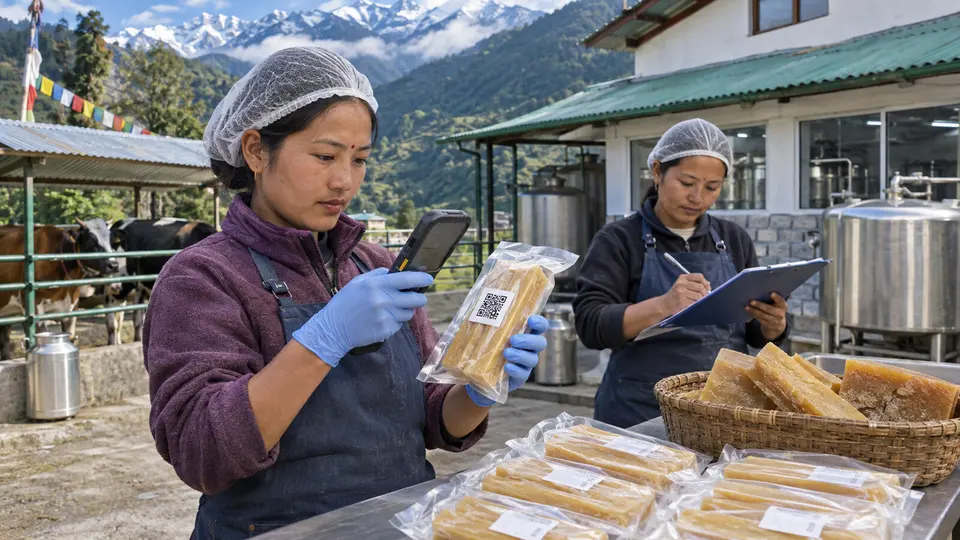
Sikkim has launched a traceability initiative for Churpi, the Himalayan state’s traditional dairy product, alongside a new microbiology laboratory intended to strengthen testing, quality assurance and food safety.
The programme was unveiled at a Sikkim Milk Union event in Gangtok on 3 November. The government said traceability is intended to reinforce the product’s identity and marketability, while the laboratory at Karfectar will support microbiological assessment across the dairy value chain.
Provenance can become a market asset
Traceability links a finished product to information about its origin, processing and movement. For a traditional food made across many small production units, a reliable record can help buyers verify batches, investigate a quality complaint and distinguish authentic product from loosely labelled substitutes.
The commercial opportunity is not the label alone. Traceability becomes valuable when the underlying records are accurate, producers use consistent standards and buyers can act on the information. A code that only opens a promotional page does not provide the same assurance as a system connected to batch, testing and producer records.
Sikkim’s initiative is being introduced as the state expands dairy infrastructure and cooperatives. The government said milk production has grown 79% over the past decade and the number of dairy cooperative societies has risen 88%. It also announced plans for 15 new societies in North Sikkim.
Testing and records must work together
The microbiology laboratory can support traceability by attaching credible quality results to identifiable batches. This is especially relevant for products that vary by milk source, process and moisture content.
The event also included Fodder Plus products developed by farmer producer organisations, linking feed availability and producer aggregation to the broader dairy strategy. A centre of excellence for indigenous Siri cattle and modernisation of the Mangan dairy plant were announced as further steps.
For Churpi producers, the next questions are practical: who records the data, what information a buyer can see, how small producers are enrolled, and whether the system supports recall and complaint handling. Costs must also remain proportionate for cooperatives and household-scale units.
If implemented with verifiable batch data and common standards, the initiative could improve buyer confidence and create room for differentiated, higher-value products. Its success should be measured through producer participation, traceable sales, rejected-batch rates and access to markets beyond the state.
Source: Department of Animal Husbandry and Dairying via PIB, 3 November 2026.
This article is journalism and commentary. It is not a recommendation to buy or sell any security, and it is not professional advice. Read the full disclaimer.