SEBI issued a consultation paper on 13 October 2026 proposing that monitoring agencies report directly to stock exchanges on how companies use money raised in public issues, according to a Corplawupdates summary. The paper is a draft, and public comments are due on 3 November 2026. The summary says the paper gives no adoption timetable.
The proposals
Monitoring agencies would report to exchanges within set timelines. If a listed company does not cooperate, the agency would report on the best available information with a "Statement of non-cooperation". Exchanges would then fine the company ₹50,000 for each instance reported. Non-payment of the agency's fees would not count as non-cooperation, and a company that cures its default would give the agency complete information, which must then report in full within 15 days. While non-cooperation continues, the company could not terminate its agency or appoint a new one.
Escalation
Under the exchange procedure the paper summarises, exchanges would write to the company within 30 days of the report's due date, then to promoters 15 days later if the default continues, and 10 days after that, if it is still unresolved, ask the depositories to freeze promoters' demat accounts.
What the rules say today
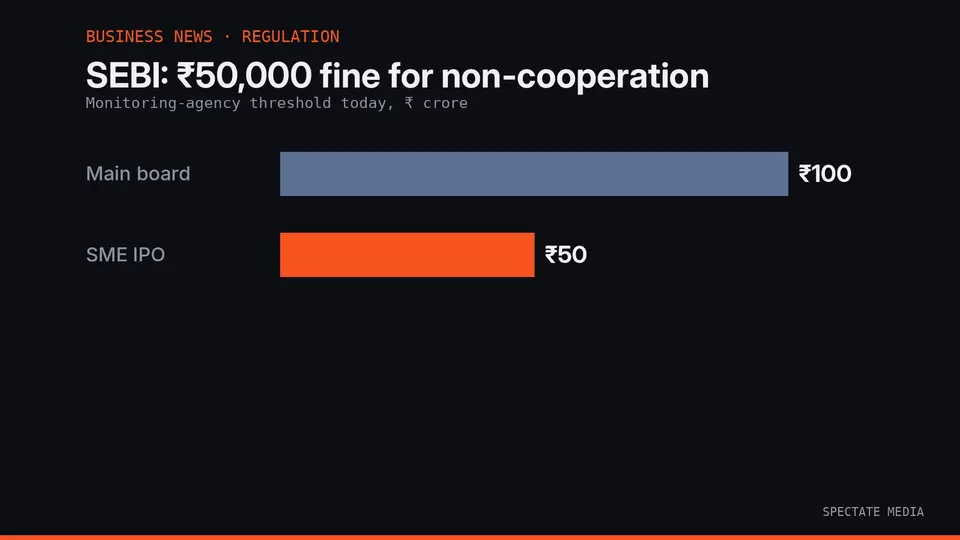
Under the ICDR regulations, a monitoring agency is required only where an issue exceeds ₹100 crore, excluding any offer for sale, and for SME IPOs where the fresh issue exceeds ₹50 crore. Reports are quarterly and are filed with the exchange within 45 days of quarter-end.
The Working Group
The paper draws on a working group chaired by V S Sundaresan, a former SEBI executive director, and covers only the first chapter of its report, on use of issue proceeds. The group also suggested a monitoring agency for every issue, whatever its size, and a new LODR Regulation 32A; the paper does not set out what the regulation would say.
Key numbers
- Fine per instance: ₹50,000 (Proposed, for non-cooperation)
- Comments due: 3 Nov 2026 (Consultation paper)
- Today's main-board threshold: ₹100 crore (Issue size, excluding OFS)
- Today's SME threshold: ₹50 crore (Fresh issue)
What boards and CFOs should note
Three points stand out. First, a ₹50,000 fine is small, but the demat freeze at the end of the chain is not. Second, a company in default could not change its monitoring agency. Third, the thresholds could be lowered, which would bring smaller issues into scope.
Source: Corplawupdates, 13 October 2026. This is a summary of a news report, published as general information. It is not legal, tax or investment advice.
This article is journalism and commentary. It is not a recommendation to buy or sell any security, and it is not professional advice. Read the full disclaimer.