
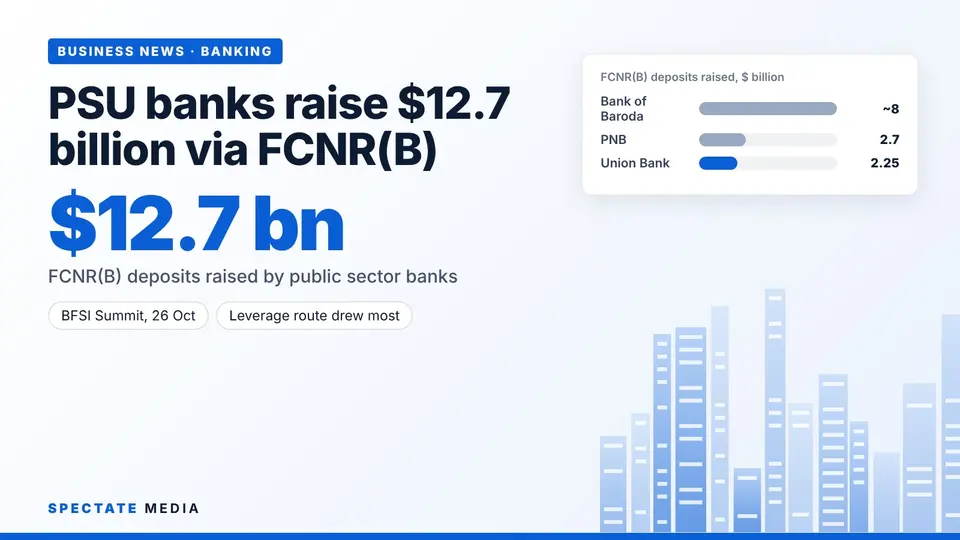
Public sector banks mobilised around $12.7 billion through FCNR(B) deposits, according to Business Standard's report of 26 October 2026 on a session at its BFSI Summit in Mumbai. The chiefs of five state-run banks spoke. Spectate Media has not seen the session and relies on the report. The bank figures it quotes add up to more than $12.7 billion, and the report does not reconcile the two.
What each bank said
Bank of Baroda's Debadatta Chand said it raised almost $8 billion. Punjab National Bank's Ashok Chandra said about $2.7 billion, with roughly 67% through the leverage route and 33% through traditional FCNR(B) deposits. Union Bank of India's Asheesh Pandey said about $2.25 billion through FCNR(B), plus $600 million from a foreign-currency bond, its first in 14 years. SBI gave no total, but its Rama Mohan Rao Amara said about 80% of depositors chose leverage, at 4 to 9 times. Indian Bank's Binod Kumar said the latest mobilisation was substantially higher than the previous round.
How the RBI swap window helped
Chandra said banks would ordinarily bear hedging costs of about 3.5%. Indian Bank said the RBI bore about half the swap cost in the previous exercise and the entire cost this time. Amara said guidance on leverage and standby letters of credit was available from the start, unlike in 2013, when clarity came near the end. SBI said it could offer about 6% to 7% on 3-to-5-year dollar deposits, against about 3.5% to 4% earlier.
Checks on the money
Indian Bank ran enhanced due diligence and found about 90% of its customers were existing borrowers. Banks verified the source of funds and collected net-worth certificates. Roadshows and GIFT City helped reach overseas investors, per PNB and Indian Bank. Another Business Standard report of the same day quotes Axis Bank's chief executive at $14.3 billion of inflows through the scheme, a different figure that the reports do not reconcile.
Key numbers
- Public sector banks, FCNR(B): About $12.7 billion (As reported)
- Bank of Baroda: Almost $8 billion (Largest of those that gave totals)
- PNB leverage share: About 67% (Of its $2.7 billion)
- SBI depositors using leverage: About 80% (At 4 to 9 times)
What boards and CFOs should note
Three points. First, the leverage route means much of the headline figure is borrowed money lent against the deposit, not fresh savings. Second, the RBI absorbing the full swap cost shifts the expense to the central bank. Third, headline inflow totals differ between reports, so treat the figures as indicative until the RBI publishes its own.
Source: Business Standard, 26 October 2026. This is a summary of a news report, published as general information. It is not legal, tax or investment advice.
This article is journalism and commentary. It is not a recommendation to buy or sell any security, and it is not professional advice. Read the full disclaimer.