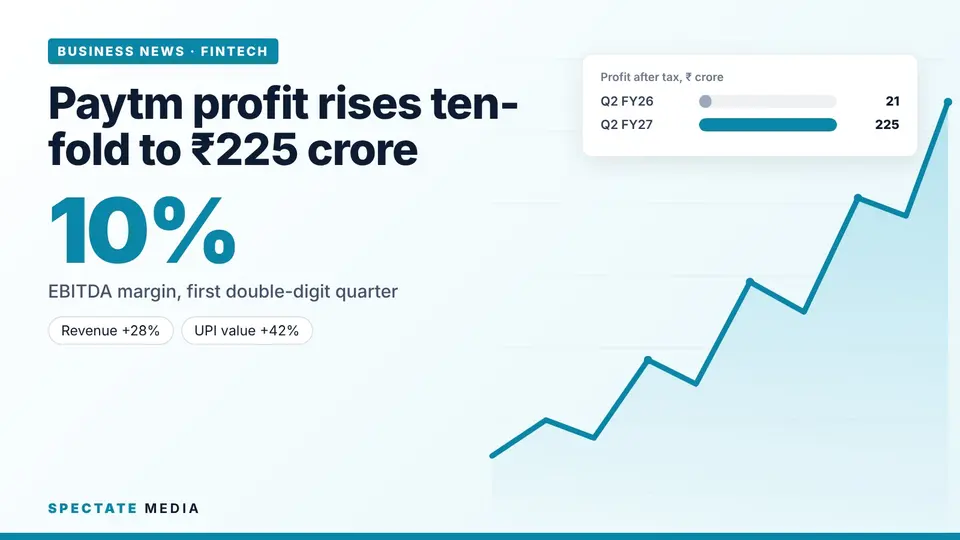
One 97 Communications, which runs Paytm, reported profit after tax of ₹225 crore for the quarter ended 30 September 2026, up from ₹21 crore a year earlier, according to Business Standard's report of 26 October. Economic Times puts the figure at ₹226 crore. Spectate Media has not seen the company's filing and relies on those reports.
Revenue and margins
Operating revenue rose 28% to ₹2,648 crore. EBITDA rose 90% to a record ₹270 crore, and the EBITDA margin reached 10%, the first time in double digits. The company says that excluding a Payments Infrastructure Development Fund incentive received until December 2025, revenue grew 33%, EBITDA nearly quadrupled and the margin rose from 3% to 10%. Profit for the first half rose to ₹445 crore from ₹144 crore. It was the sixth profitable quarter in a row. Indirect expenses fell to 46% of revenue from 52%, which management attributes to AI-led efficiencies.
Payments and distribution
UPI transaction value grew 42% year on year, against 19% for the industry, and Paytm gained consumer UPI share for a sixth consecutive quarter. Monthly transacting users rose by 1 crore to 8.5 crore. Payment services revenue rose 25% to ₹1,434 crore. Subscription merchants rose by 27 lakh to 1.64 crore. Distribution revenue rose 49% to ₹912 crore, driven by merchant loans, personal loans, postpaid, margin trading funding and gold. Repeat borrowers were more than half of merchant loan disbursements. Cash stood at ₹13,617 crore.
What the report leaves out
It gives no quarter-on-quarter figures and no detail on merchant discount rates or UPI incentives. Management says growth and margin expansion should continue to compound, citing AI-driven operating leverage.
Key numbers
- Profit after tax: ₹225 crore (From ₹21 crore a year earlier)
- Operating revenue: ₹2,648 crore (+28% year on year)
- EBITDA margin: 10% (First double-digit quarter)
- UPI transaction value: +42% (Industry: +19%)
What boards and CFOs should note
Three points. First, the headline profit multiple comes from a small base of ₹21 crore. Second, the comparable growth figures strip out an incentive that has ended, which is the cleaner read of the business. Third, the loan distribution business is now growing faster than payments. Not investment advice.
Source: Business Standard, 26 October 2026. This is a summary of a news report, published as general information. It is not legal, tax or investment advice.
This article is journalism and commentary. It is not a recommendation to buy or sell any security, and it is not professional advice. Read the full disclaimer.