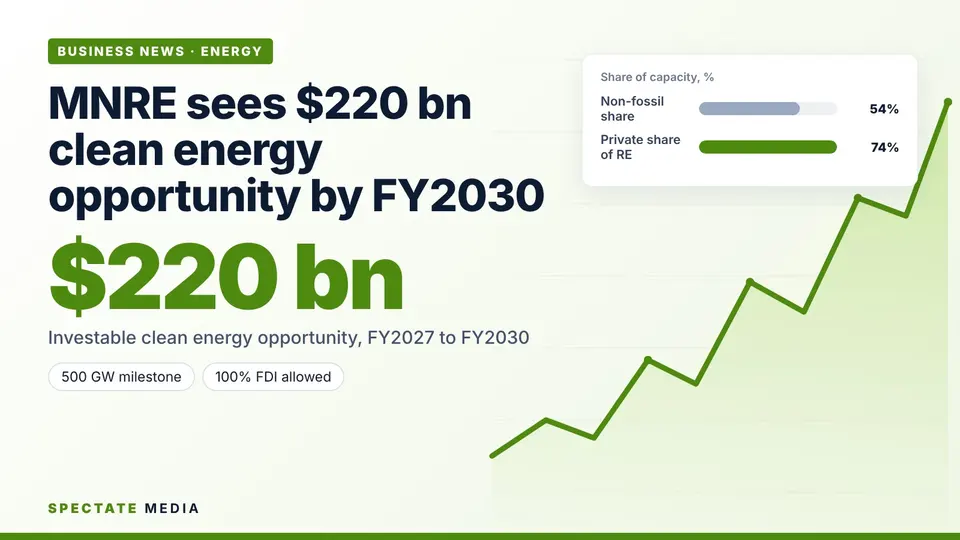
India has about $220 billion of investable opportunities across the clean energy value chain between FY2027 and FY2030, according to the Ministry of New and Renewable Energy (MNRE), as reported by ANI on 23 October 2026. Other outlets carried the same figure this week. Spectate Media has not seen the ministry's own material and relies on ANI.
What was said
J.V.N. Subramanyam, a joint secretary at MNRE, said the private sector is the largest partner in the power-sector transformation and that the 500 GW target for non-fossil capacity cannot be financed by the public sector alone. He said he does not see $220 billion as a constraint but as a measure of the opportunity. He called 500 GW a milestone, with 1,800 GW of non-fossil capacity by 2047 and net-zero emissions by 2070 as the longer goals.
The numbers
Non-fossil sources make up over 54% of India's installed power capacity, and private entities account for nearly 74% of renewable capacity, per the report. The investment spans solar and wind, storage, manufacturing, transmission, green hydrogen and hydropower; ANI gives no split by segment. One other outlet's headline says India has installed 308 GW of non-fossil capacity and attributes the remarks to the MNRE secretary, while ANI names a joint secretary and gives no 308 GW figure, so Spectate Media has not used either detail.
Policy support cited
The ministry pointed to 100% FDI under the automatic route, a 500 MW contract-for-difference pilot through SECI, and a cut in GST on renewable equipment from 12% to 5%. The Bharat Renewable Energy Summit and Expo runs from 2 to 5 November at Bharat Mandapam in New Delhi.
Key numbers
- Investable opportunity: About $220 billion (FY2027 to FY2030)
- Non-fossil share: Over 54% (Of installed capacity)
- Private share: Nearly 74% (Of renewable capacity)
- GST on RE equipment: 12% to 5% (Cited as support)
What boards and CFOs should note
Three points. First, the $220 billion is an opportunity estimate for a four-year window, not committed spending. Second, private capital already dominates the sector, so financing and payment security matter most. Third, the figure has no segment breakdown, so it cannot yet be mapped to a particular business.
Source: ANI, 23 October 2026. This is a summary of a news report, published as general information. It is not legal, tax or investment advice.
This article is journalism and commentary. It is not a recommendation to buy or sell any security, and it is not professional advice. Read the full disclaimer.