India's crude oil import bill rose 47% from a year earlier to $15.4 billion in September 2026, according to NewsBytes on 16 October, which attributes the rise to costs linked to the West Asia conflict. Imports were 21.7 million tonnes, up 7%. Spectate Media has not seen the underlying government release.
Price, not volume
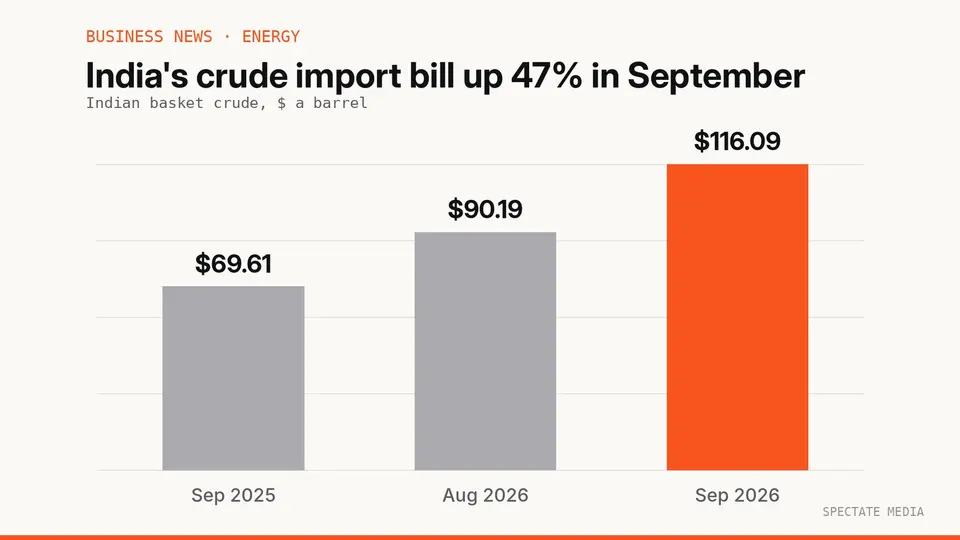
Spectate Media's calculation from those two figures gives about $710 a tonne. ThePrint, citing the Petroleum Planning and Analysis Cell (PPAC), reports that the Indian basket averaged $116.09 a barrel in September, against $90.19 in August and $69.61 in September 2025. That is about 67% above a year ago, which fits a bill that rose far faster than volume.
Half-year view
For April to September, the bill was $90.6 billion, up 46.3% from $61.9 billion, on 122.7 million tonnes against 121.8 million. Import dependence was 88.1%, and domestic crude and condensate output fell to 13.7 million tonnes from 14.2 million. The net oil and gas import bill for September widened nearly 40% to $13.4 billion, and petroleum product export earnings rose 20% to $4.8 billion even though volume fell 24.2%, according to NewsBytes.
Demand signals
PPAC data show petroleum product consumption in April to September fell 3.3% to 114.8 million tonnes. LPG fell 15.5% and naphtha 18%, while diesel rose 4.9% and petrol 7.1%.
Key numbers
- Crude import bill, September: $15.4 billion (Up 47% year on year)
- Crude volume, September: 21.7 million tonnes (Up 7%)
- Indian basket, September: $116.09 a barrel (From $69.61 a year earlier)
- Import bill, April to September: $90.6 billion (Up 46.3% from $61.9 billion)
What boards and CFOs should note
Three points stand out. First, the import bill is following the crude price, so fuel-heavy businesses are exposed to oil prices more than to volumes. Second, higher fuel costs add to the inflation concerns the RBI described this week. Third, falling domestic output keeps import dependence high.
Source: NewsBytes, 16 October 2026. This is a summary of a news report, published as general information. It is not legal, tax or investment advice.
This article is journalism and commentary. It is not a recommendation to buy or sell any security, and it is not professional advice. Read the full disclaimer.