The International Financial Services Centres Authority (IFSCA) issued algorithmic trading guidelines for GIFT City stock exchanges on 16 October 2026, according to a Corplawupdates summary of circular IFSCA/CMD-DMIIT/ALGO/2026-27/01. The circular is effective immediately and replaces SEBI's algo trading circulars as they applied in the IFSC. Spectate Media has not seen the circular itself.
Who is covered
Stock exchanges in GIFT IFSC (the report names India INX and NSE IFSC), broker-dealers and remote trading participants. Algorithmic trading means an automated system that decides order parameters with limited or no human intervention; systems that only process, confirm or settle orders are excluded.
What exchanges must do
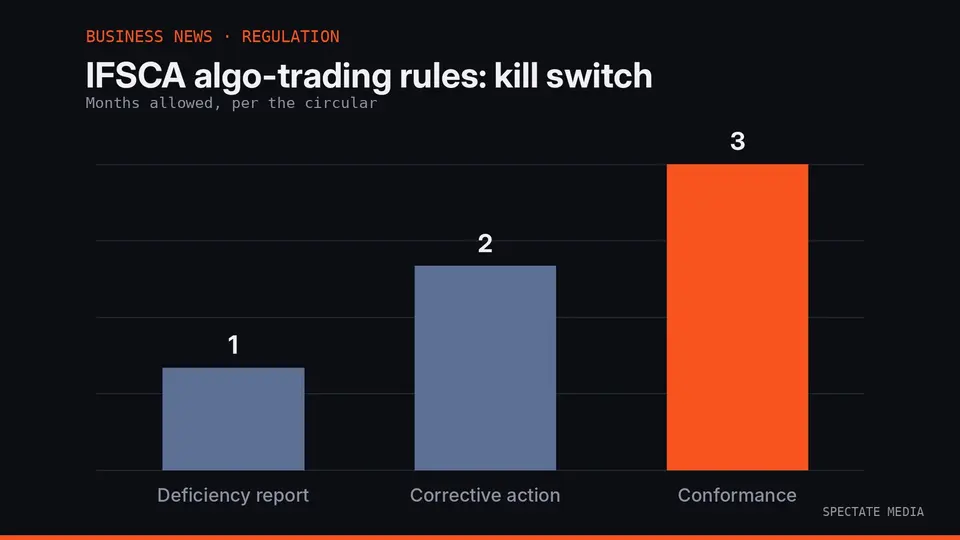
Exchanges must give express approval before any algorithm is deployed, synchronise clocks to an atomic clock, run conformance testing and periodic stress simulations, and apply real-time checks on price bands and quantity limits. Existing users get three months from 16 October.
What participants must do
Participants must have seven controls: price check, quantity check, order value check, a cap on cumulative open order value, automated execution check, kill switch, and capacity and stability controls. They must also give the exchange a six-point undertaking, including naming a qualified compliance or risk officer, and remain responsible for explaining how AI or machine learning affects their algorithms.
Order-to-trade ratio and audits
Exchanges may levy graded financial disincentives on excessive daily order-to-trade ratios. A participant penalised more than ten times in a rolling 30 days can be barred from proprietary trading for the opening hour of the next session. Annual system audits are required, with the same auditor limited to three successive audits followed by a two-year cooling-off period. Deficiencies must be reported within a month, with corrective action and a closure report within two months.
Key numbers
- Mandatory risk controls: 7 (Including a kill switch)
- Conformance window: 3 months (For existing users)
- Repeat OTR penalties: More than 10 (In 30 days can bar prop trading for an hour)
- Auditor cooling-off: 2 years (After three successive audits)
What boards and CFOs should note
Three points stand out. First, the kill-switch and order value controls are mandatory, not optional. Second, the three-month window means exchanges must amend bye-laws by about 16 January 2027. Third, the summary is secondary, so firms should check the circular text before acting.
Source: Corplawupdates, 17 October 2026. This is a summary of a news report, published as general information. It is not legal, tax or investment advice.
This article is journalism and commentary. It is not a recommendation to buy or sell any security, and it is not professional advice. Read the full disclaimer.