
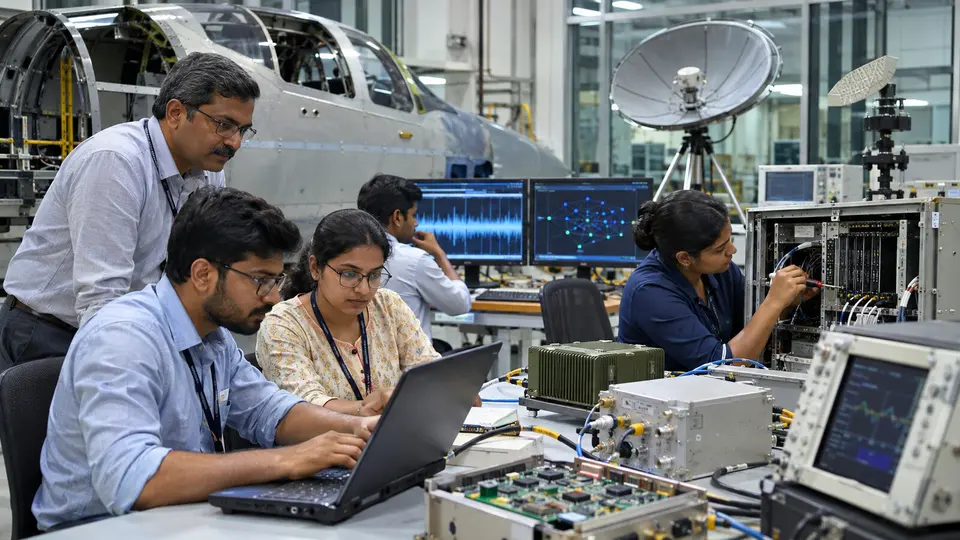
The Indian Air Force’s Software Development Institute has signed an agreement with IIT Madras and IITM Pravartak Technologies Foundation to jointly design an indigenous digital secure communication system for airborne applications.
The partners will work on advanced algorithms for communications and networking. The stated objective is to reduce reliance on imported systems while improving operational efficiency, according to the Ministry of Defence.
Why airborne communications are demanding
Aircraft communication equipment must operate under constraints that differ from fixed terrestrial networks. Hardware has to cope with motion, vibration, limited power and space, contested radio environments and the need for low-latency, reliable links.
Security is not a single software feature. It involves cryptography, key management, authentication, hardware assurance, network design and procedures for updating systems without disrupting operational readiness.
The official release does not disclose the system architecture, frequency bands, aircraft platform, delivery schedule or project value. Those omissions are appropriate for a defence-development programme but limit any assessment of commercial scale.
A research-to-deployment pathway
The Software Development Institute brings operational requirements and integration experience, while IIT Madras and IITM Pravartak contribute research and technology-development capability. The partnership can shorten the distance between laboratory algorithms and a system tested against real airborne constraints.
For domestic electronics and aerospace suppliers, a successful design may create opportunities in radios, processors, antennas, ruggedised enclosures, testing and lifecycle support. No supplier contracts or production orders have been announced.
What progress would look like
- Defined technical and security requirements
- Working laboratory prototypes
- Hardware-in-the-loop and interference testing
- Airworthiness and cybersecurity assurance
- Flight trials under representative conditions
- A production and maintenance plan
What the innovation ecosystem should watch
The most important checkpoint is not the signing of the agreement but verified performance in trials. Communication algorithms that work in a controlled lab must retain reliability and security when channels degrade or an adversary attempts disruption.
Intellectual-property ownership and the route to production will also matter. Research institutions can create the core design, but deployment requires manufacturing quality, component availability, certification and long-term configuration control.
The partnership may also create reusable capability in secure networking, signal processing and embedded systems. Those skills can support civilian aerospace and other safety-critical communications, although the present agreement is specifically for IAF airborne applications and does not announce a commercial product.
Testing should include failure modes as well as peak performance. Engineers will need to demonstrate graceful degradation, secure recovery and predictable behaviour when links are congested, jammed or partially unavailable.
Domestic development can reduce import dependence only if the system remains supportable over its operating life. That means documented interfaces, secure update mechanisms and access to replacement components rather than a one-time prototype.
The project is an early development collaboration, not an announcement that a system has entered service. Technical milestones and flight-test outcomes will provide the evidence needed to judge the programme’s impact.
Source: Ministry of Defence release published by the Press Information Bureau on 6 November 2026.
This article is journalism and commentary. It is not a recommendation to buy or sell any security, and it is not professional advice. Read the full disclaimer.