
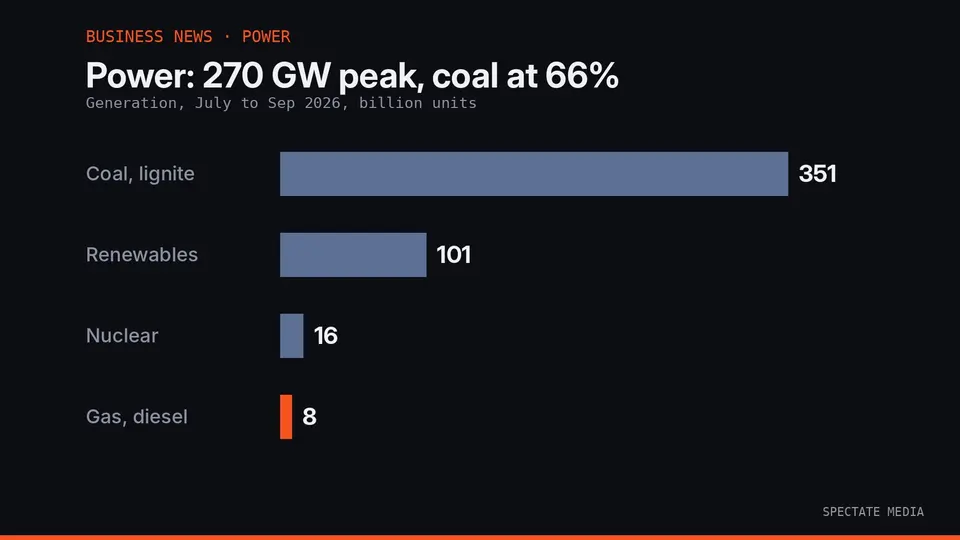
India's peak electricity demand reached 270 GW on 16 July 2026, according to a quarterly review by the Centre for Research on Energy and Clean Air (CREA), published on 12 October. The peak was 40 GW above the 230 GW of the same quarter a year earlier. CREA calls that 18%; Spectate Media's own calculation from the two figures gives about 17%. The review uses data from GRID-INDIA, the Ministry of Coal, the Central Electricity Authority and the National Power Portal.
Generation
Total generation in July to September rose 11% to 536 billion units. Coal and lignite produced 351 billion units, about 66% of the total and 12.5% more than a year earlier, and accounted for 73% of the increase. Coal plants ran at a load factor of 68%, against 62%. Solar generation rose 39%, wind 29% and nuclear 26%, while large hydro fell 20%. Renewables other than large hydro passed 100 billion units, at 101, for the first time.
Coal supply
Coal stocks at power plants fell to 21 million tonnes on 30 September, 36% of the 58 million tonne norm. The number of plants holding less than 25% of the norm rose from 32 on 22 August to 85 on 1 October. Coal production fell 4.3% in August, the lowest monthly output of the year. A separate report in Domain-b, citing the Coal Ministry, put plant stocks at 18.205 million tonnes on 10 October, and says Coal India's average e-auction premium reached 94% in September from 59% in August.
Capacity
Installed capacity was 555 GW in August 2026, up 12% in a year. Renewables other than large hydro were 243 GW, or 44%, and coal and lignite 231 GW, or 42%. CREA says curtailment of about 1,835 million units in July and August was due to limited transmission.
Key numbers
- Peak demand: 270 GW (16 July 2026, from 230 GW)
- Total generation: 536 billion units (Up 11%)
- Coal plant stocks, 30 September: 21 million tonnes (36% of the 58 million tonne norm)
- Solar generation: Up 39% (Fastest-growing major source)
What boards and CFOs should note
Three points stand out. First, record demand was met mostly by coal while stocks fell, which matters for energy-intensive industry. Second, solar growth is rapid but is not yet covering evening peaks. Third, coal supply and auction prices are worth watching for power-intensive firms.
Source: Centre for Research on Energy and Clean Air, 12 October 2026. This is a summary of a news report, published as general information. It is not legal, tax or investment advice.
This article is journalism and commentary. It is not a recommendation to buy or sell any security, and it is not professional advice. Read the full disclaimer.