
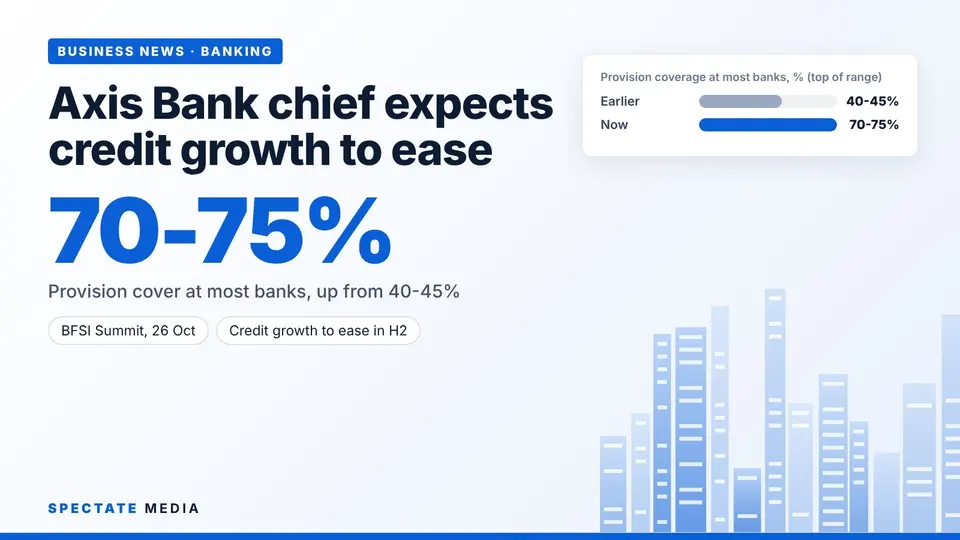
Axis Bank's managing director and CEO Amitabh Chaudhry said credit growth is expected to ease in the second half of the year, as the favourable base effect from the first half fades, according to Business Standard's report of 26 October 2026. He spoke at its BFSI Insight Summit in Mumbai. Spectate Media has not seen the session and relies on the report.
Liquidity and funding costs
Banks had expected liquidity to stay comfortable for a couple of quarters after about $14.3 billion of inflows through the FCNR(B) deposit scheme, he said. The RBI later absorbed some of the excess liquidity, which pushed up incremental deposit rates. Higher deposit rates could raise banks' funding costs. Expected interest rate hikes, rising inflation and West Asia uncertainty could add pressure, and higher borrowing costs could affect credit demand and repayment capacity. Another Business Standard report of the same day puts public sector banks' FCNR(B) inflows at $12.7 billion, a different figure that the reports do not reconcile.
What still supports lending
Chaudhry cited longer working capital cycles, higher inventory needs, infrastructure and project finance demand, and expansion into underserved areas. He said NBFCs are supporting credit expansion. Retail lending is expected to grow faster than wholesale over the next 18 to 24 months, provided risks stay manageable, and deposit mobilisation is essential for further growth.
Buffers
Capital levels are about 500 basis points higher than in the previous high-growth cycle, he said. Provision coverage has risen from around 40% to 45% to 70% to 75% at most banks. New expected credit loss norms are due from April. He noted reports of cyberattacks on Indian financial institutions and a suspected data breach at SBI. On the IRDAI's proposed insurance distribution rules, which are at an early consultation stage, he said banks will assess the final norms before deciding how to respond.
Key numbers
- Provision cover, most banks: 70% to 75% (From about 40% to 45%)
- Capital versus last cycle: About 500 bps higher (As stated by the CEO)
- FCNR(B) inflows cited: About $14.3 billion (PSU banks: $12.7 billion, per another report)
- ECL norms: From April (New expected credit loss rules)
What boards and CFOs should note
Three points. First, the base effect that helped first-half credit growth will not repeat, so second-half targets will be harder. Second, funding costs are the likeliest pressure point. Third, the expected credit loss norms from April will change how banks provision, which borrowers may notice in pricing.
Source: Business Standard, 26 October 2026. This is a summary of a news report, published as general information. It is not legal, tax or investment advice.
This article is journalism and commentary. It is not a recommendation to buy or sell any security, and it is not professional advice. Read the full disclaimer.