
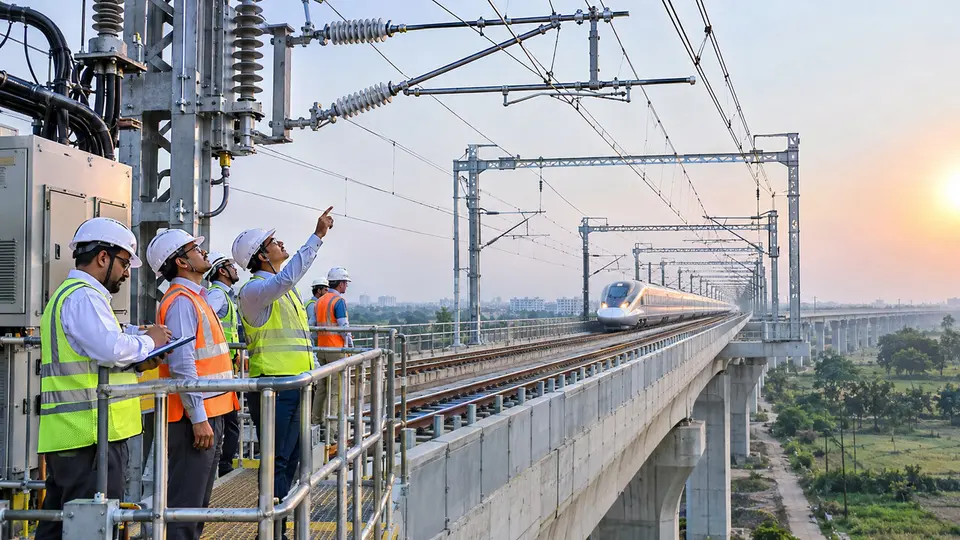
The overhead traction system on the 50 km Surat–Bilimora section of the Mumbai–Ahmedabad bullet-train corridor has been energised, moving India’s first high-speed rail project closer to testing.
The elevated section carries both Up and Down lines between the two Gujarat stations and uses an advanced 2 × 25 kV overhead traction system.
Power enables the next testing phase
Energisation means the electrical installation is live and can support further testing activity. It does not mean that passenger operations have begun or that the entire corridor is ready.
The 508 km Mumbai–Ahmedabad corridor will use 14 traction substations connected to the national grid. The first, at Bilimora in Navsari district, has completed installations across its control-panel, changeover-switch, transformer and circuit-breaker buildings.
Gujarat’s substations will receive power from GETCO’s 220 kV Ambetha grid substation. A centralised control centre will monitor the electrical network for safe and reliable operation.
The section combines civil and electrical milestones
The Surat–Bilimora alignment includes bridges over four rivers, a steel bridge over National Highway 53 and approximately 94,000 noise barriers.
Progressive energisation in smaller sections allows technical teams to verify safety and compliance before expanding the live network.
The milestone shifts attention toward integrated testing of power, signalling, track and rolling-stock systems. Delivery risk remains tied to the remaining civil works, systems integration, certification and completion of the wider corridor.
This article is journalism and commentary. It is not a recommendation to buy or sell any security, and it is not professional advice. Read the full disclaimer.