
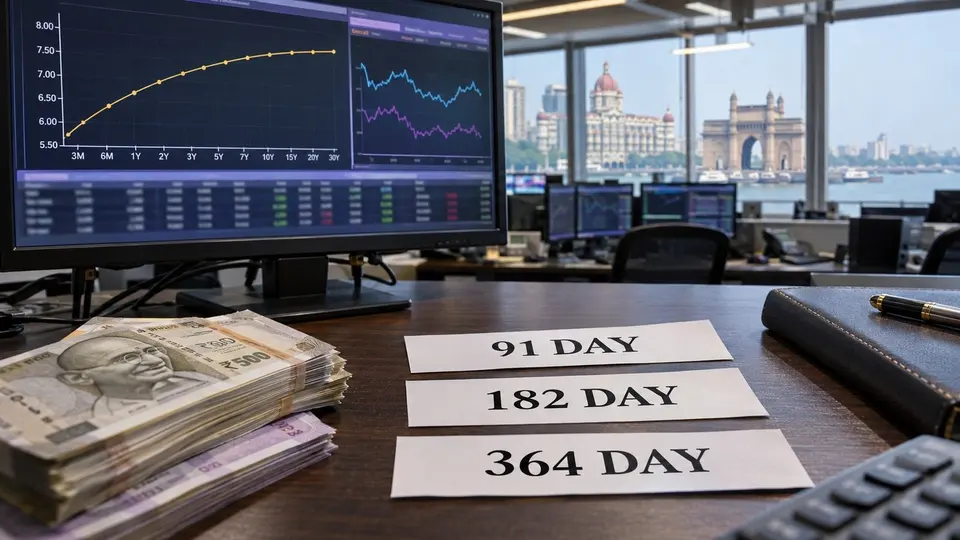
The Reserve Bank of India will auction ₹23,000 crore of Government of India Treasury bills on 18 November, covering three maturities and settling the following day, according to an official release issued on 13 November.
The notified amount comprises ₹8,000 crore of 91-day bills, ₹8,000 crore of 182-day bills and ₹7,000 crore of 364-day bills. The auction will use a price-based multiple-price method.
Auction timetable
Competitive bids must be submitted electronically through the RBI’s E-Kuber system between 10:30 am and 11:30 am on 18 November. The non-competitive window will close earlier, at 11:00 am. Results are due on the auction day, with payment and settlement scheduled for 19 November.
Treasury bills are short-dated sovereign instruments issued at a discount and redeemed at face value. The three maturities provide reference points across the front end of the government yield curve and are widely used by banks, funds and corporate treasuries for liquidity management.
The sale will be governed by the government’s general notification dated 26 March 2025, as amended. State governments, Union Territories with legislatures, eligible provident funds, designated foreign central banks and other specified persons or institutions may participate on a non-competitive basis outside the notified amount.
Retail participation
Individual investors may also submit non-competitive bids through the RBI Retail Direct portal. Retail allocation is capped at 5% of the notified amount, under the terms stated by the central bank.
The multiple-price format means successful competitive bidders pay the price quoted in their respective accepted bids. Market participants will therefore watch the cut-offs across all three tenors for signals on short-term liquidity expectations, policy-rate assumptions and demand for sovereign paper.
The maturity split is also relevant for treasury operations. A 91-day instrument carries less duration exposure than the 182-day or 364-day bill, while the longer bill can provide a higher sensitivity to changes in short-term yield expectations.
The RBI said physical bids would be accepted only in the event of a system failure and must reach its Public Debt Office before the relevant bidding window closes.
Auction yields will be read against prevailing overnight rates and expectations for banking-system liquidity. Strong demand can lower accepted yields, while weaker bids can require higher yields to place the notified stock. Those signals can travel into commercial-paper pricing, money-market fund returns and other short-duration borrowing benchmarks.
The announcement specifies the amount and process but not the eventual cut-off prices or yields. Those will be determined through bidding and published with the auction results. Investors therefore cannot infer the realised return solely from the notified maturity and amount.
Key numbers
Total notified amount: ₹23,000 crore 91-day bills: ₹8,000 crore 182-day bills: ₹8,000 crore 364-day bills: ₹7,000 crore
What boards and CFOs should note
- Treasury teams can compare auction cut-offs with bank-deposit and money-market alternatives for short-term cash.
- The three maturity buckets allow liquidity to be aligned with different operating and payment horizons.
- Competitive bidders should account for multiple-price execution rather than assuming a single uniform auction price.
Source: Reserve Bank of India, 13 November 2026. This is a summary of an official release, published as general information. It is not legal, tax or investment advice.
This article is journalism and commentary. It is not a recommendation to buy or sell any security, and it is not professional advice. Read the full disclaimer.