
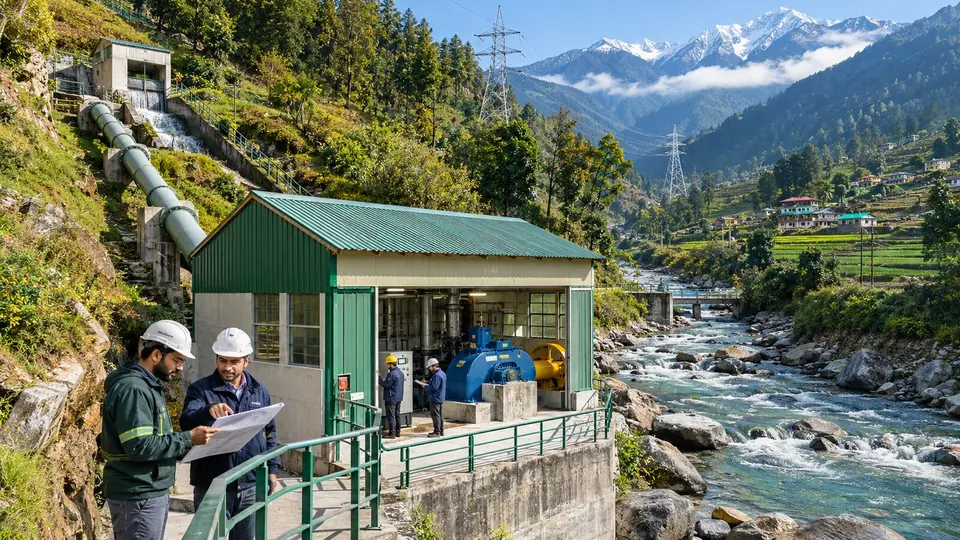
India’s new small-hydropower programme is expected to attract about ₹15,000 crore of investment while adding roughly 1,500 MW of capacity by 2030–31.
The government has approved an outlay of ₹2,584.60 crore for the scheme, which prioritises hilly, north-eastern and border regions where smaller run-of-river projects can serve remote demand.
Financial support is weighted toward difficult terrain
Projects in north-eastern states and international-border districts can receive assistance of ₹3.6 crore per MW or 30% of project cost, whichever is lower, capped at ₹30 crore per project.
Other locations can receive support based on project size and location, subject to 20% of project cost and a ₹20 crore ceiling.
India has identified 21,134 MW of small-hydro potential across 7,133 sites, but only about a quarter has been harnessed. Projects up to 25 MW fall under the small-hydro classification.
The pipeline extends beyond immediate capacity
The scheme allocates ₹30 crore to support detailed project reports for at least 200 projects, building a longer-term development pipeline. It is also expected to generate around 51 lakh person-days of construction employment and continuing operations roles.
Small hydro offers firm renewable power and grid flexibility, but project quality will depend on hydrology, environmental approvals, local consent, financing and transmission access. The programme’s investment target will therefore be judged by commissioned capacity, not approvals alone.
Source: Press Information Bureau and Ministry of New and Renewable Energy, 22 November 2026.
This article is journalism and commentary. It is not a recommendation to buy or sell any security, and it is not professional advice. Read the full disclaimer.