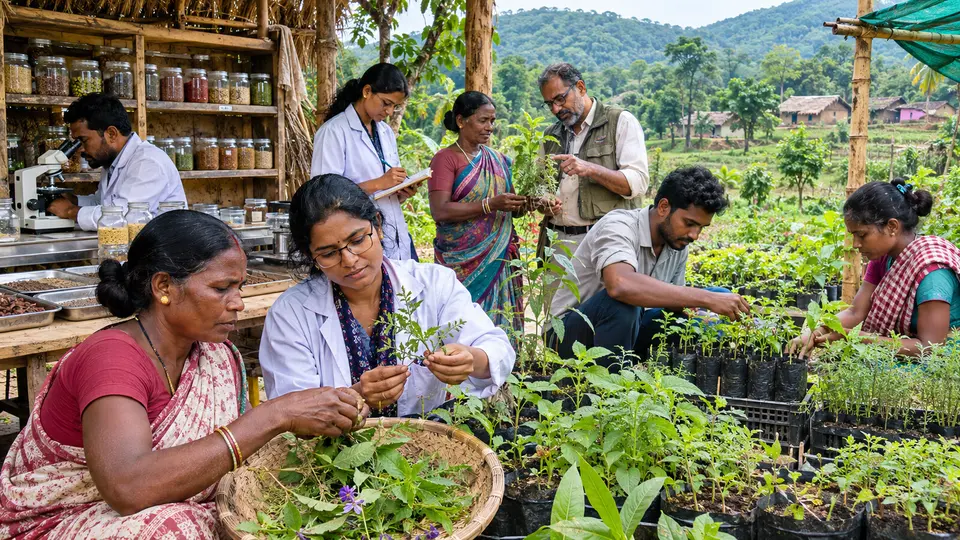
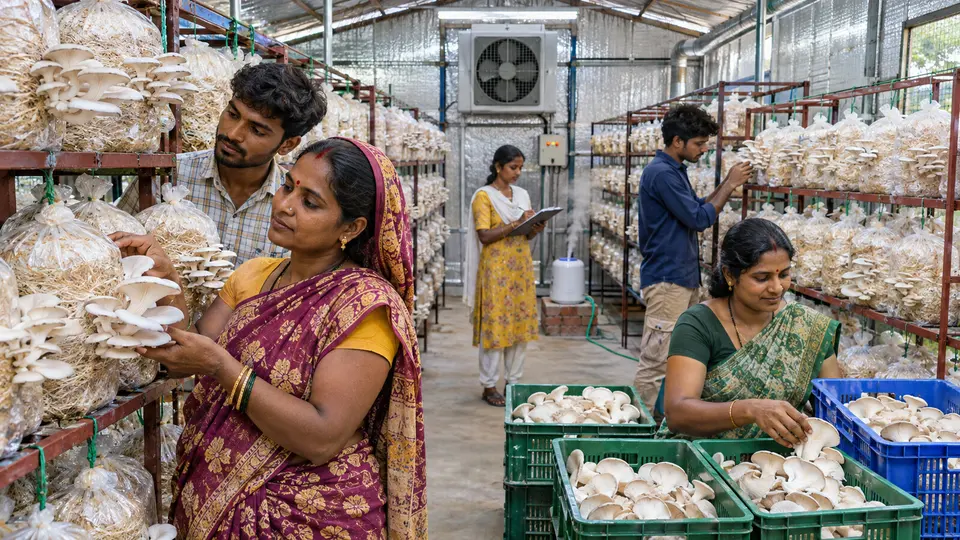
Mushroom cultivation is gaining ground as a small-scale horticulture business that can operate with limited land, short production cycles and relatively modest infrastructure, according to a government feature published on 10 November.
The crop can be grown in rural, urban and peri-urban settings using enclosed rooms or sheds. Substrates can incorporate agricultural residues, giving growers a route to turn low-value biomass into a higher-value food product.
A different entry point into horticulture
Unlike field crops, mushrooms do not require a large cultivated plot. Production depends instead on clean spawn, prepared substrate, temperature and humidity control, hygiene and timely harvesting. That makes the model accessible to farmers seeking diversification as well as women and rural youth building a standalone enterprise.
The short cycle can produce revenue more quickly than perennial horticulture. It can also support linked businesses in spawn production, grow-bag preparation, equipment, training, aggregation, processing and local delivery.
But low land use does not mean low operating risk. Contamination can damage a crop rapidly, while fresh mushrooms have a limited shelf life. Growers need consistent technical practice and a buyer network that can absorb output soon after harvest.
Market access determines viability
Local restaurants, retailers and direct-to-consumer channels can support small volumes. Larger operations need grading, packaging, refrigeration and predictable procurement. Drying, powdering and other processing can extend shelf life, although these products require their own quality standards and demand development.
The government feature describes mushroom cultivation as a livelihood pathway, but it does not provide national production, price or enterprise-survival data. Those measures are necessary to judge whether training-led projects become durable businesses.
For lenders and producer organisations, the commercial questions include spawn quality, contamination rates, energy costs, realised selling prices and the distance to market. A unit that performs well in a training setting may struggle if several local growers harvest simultaneously without aggregation or cold storage.
The sector’s opportunity lies in matching decentralised production with disciplined quality control and dependable sales. Public programmes can lower the entry barrier, but repeat orders—not the number of grow bags distributed—will determine whether mushroom cultivation becomes a stable rural enterprise.
Source: PIB feature, 10 November 2026.
This article is journalism and commentary. It is not a recommendation to buy or sell any security, and it is not professional advice. Read the full disclaimer.