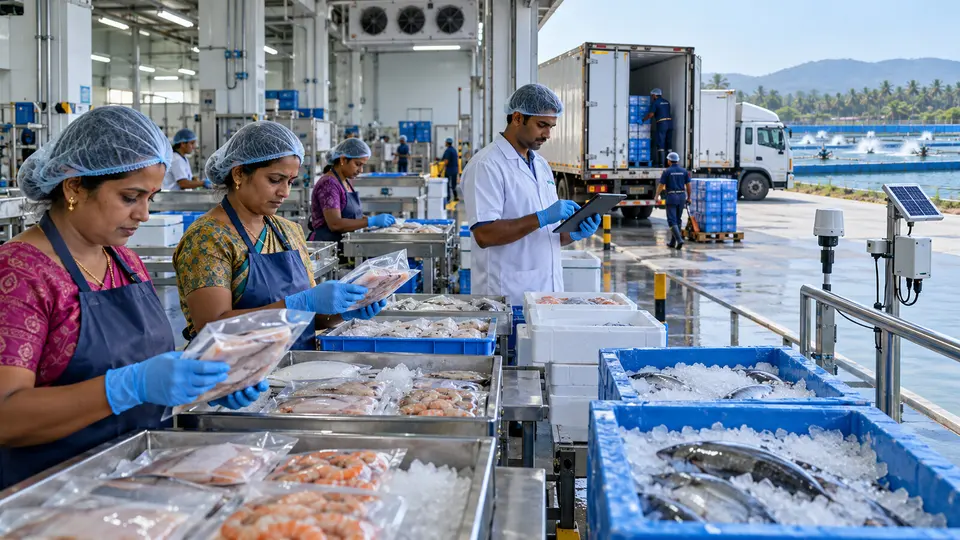
India's fisheries strategy is moving beyond higher output toward a technology-enabled value chain built around processing, traceability, cold storage, logistics and direct market access.
The Department of Fisheries said public programmes have committed ₹39,272 crore since 2015 across the Blue Revolution, the Fisheries and Aquaculture Infrastructure Development Fund, the Pradhan Mantri Matsya Sampada Yojana and related schemes. A further ₹3,393.85 crore has supported 46,500 transport, market, cold-storage, feed, ice and value-addition facilities.
The emerging-business opportunity sits between the farm gate and the consumer. Ready-to-cook products, branded seafood, smart cold chains and mobile retail can extend shelf life, reduce losses and improve producer price realisation. The government also pointed to the use of artificial intelligence, internet-connected sensors, blockchain, drones and precision aquaculture for production, quality control and traceability.
Producer aggregation is another part of the model. The department said 2,195 fisheries farmer-producer organisations have been supported, with several linked to the Open Network for Digital Commerce. Under PM-MKSSY, 5,500 fisheries cooperatives are being strengthened to operate as producer organisations.
Women-led enterprises are a substantial part of the transition. Projects worth more than ₹4,155 crore have been approved over five years for more than 1.28 lakh women beneficiaries, including processing, packaging, mobile vending and small retail businesses.
The commercial test is whether this infrastructure raises utilisation and creates repeat demand beyond scheme-led capital spending. Reliable cold-chain operations, consistent quality standards and access to working capital will determine how much value reaches producers.
Source: Department of Fisheries via Press Information Bureau.
This article is journalism and commentary. It is not a recommendation to buy or sell any security, and it is not professional advice. Read the full disclaimer.