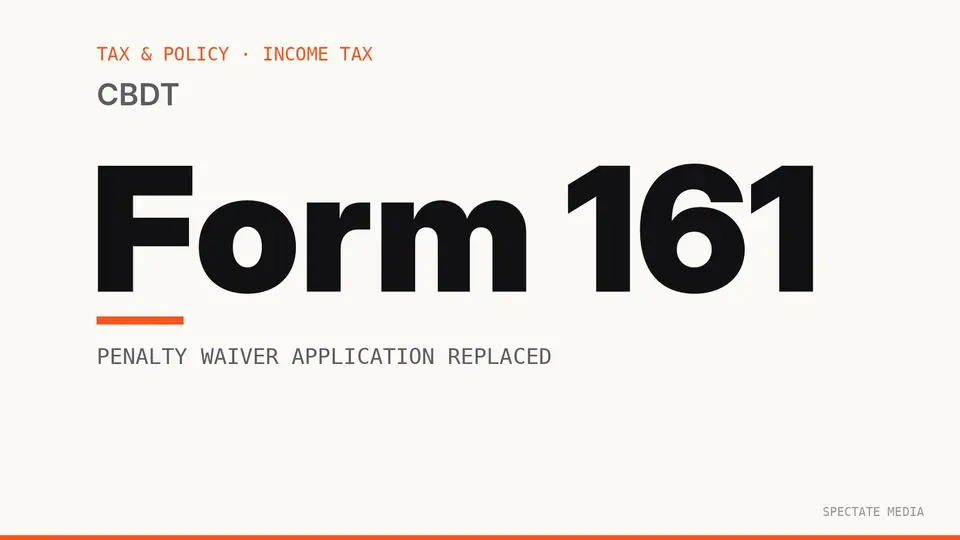
The Central Board of Direct Taxes has replaced Form 161, the application form for seeking a penalty waiver under the Income Tax Act 2025, according to India Briefing. The change comes through the Income-tax (Sixth Amendment) Rules, 2026, which the report says were issued on 8 October 2026. The amended rules take effect on publication in the Official Gazette.
What changed
Rule 231 now reads "imposition or waiver", with the words "or waiver" inserted after "imposition". That extends the rule to penalty waivers. The old Form 161 has been replaced with a revised form, titled "Application for seeking waiver of penalty under Section 440(2) of the Income Tax Act 2025".
What the revised form asks
The revised form asks for details of the assessment or reassessment order, the under-reported income, the tax and interest payable, and the payments made. Applicants must declare that no appeal has been filed against the specified order. They must also undertake not to file one before the period in Section 440(5) expires.
Who can apply
The report lists individuals facing a penalty linked to an assessment or reassessment order, and companies and other businesses facing penalties related to under-reported income. It also lists taxpayers with outstanding tax demands and the tax professionals who assist them. The report states that the notification does not introduce an automatic penalty waiver for all taxpayers, and that eligibility depends on Section 440 and related provisions.
A caution on the source
India Briefing's article does not cite the Gazette notification, and the report gives no notification number. Readers should check the official text before relying on these details.
Key numbers
- Rules: Sixth Amendment (Income-tax Rules, 2026)
- Notified: 8 Oct 2026 (Per India Briefing)
- Form replaced: Form 161 (Penalty waiver)
- Rule amended: Rule 231 (Adds “or waiver”)
What boards and CFOs should note
Three points stand out for finance teams. First, the amendment changes the application form and one rule, and it does not grant a general waiver. Second, applicants must give up the right to appeal the order in question, at least until the Section 440(5) period ends. Third, companies with penalties tied to under-reported income should read Section 440 and the revised form with their tax advisers.
Source: India Briefing, October 2026. This is a summary of a news report, published as general information. It is not legal, tax or investment advice.
This article is journalism and commentary. It is not a recommendation to buy or sell any security, and it is not professional advice. Read the full disclaimer.