
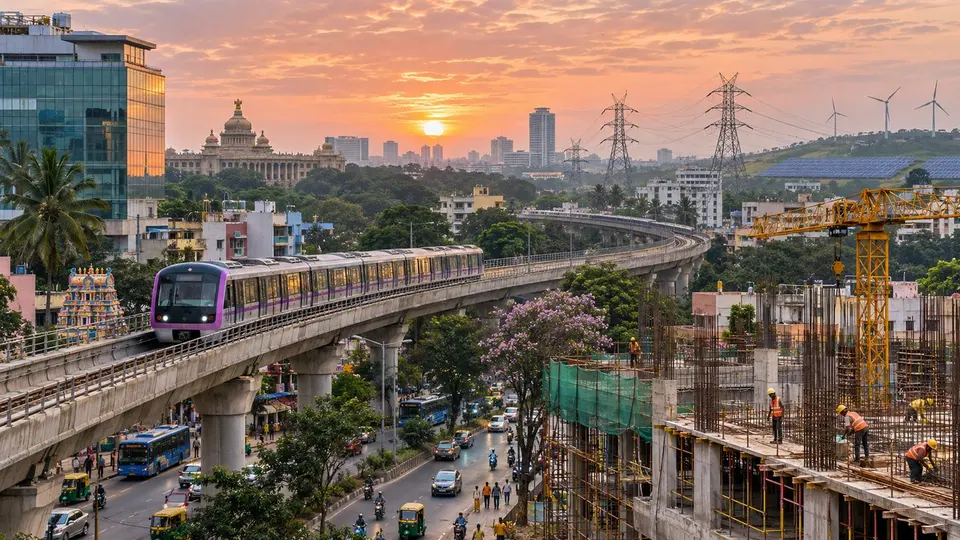
Infrastructure projects worth more than ₹15,600 crore have been inaugurated, dedicated or moved into construction across Bengaluru and Karnataka, spanning urban mobility, power transmission, renewable energy, petroleum infrastructure, waste management and railways.
The package was announced during a 13 November programme led by the Prime Minister. It combines completed assets with projects at the foundation-stone stage, so the headline amount should not be read as expenditure occurring in one period.
Metro and power networks
Bengaluru Metro’s Pink Line section from Kalena Agrahara to Tavarekere was inaugurated at an estimated cost of ₹3,470 crore. The new section is intended to strengthen public transport capacity and reduce travel times along its corridor.
The programme also included a ₹4,450 crore transmission scheme for integrating renewable-energy zones in Koppal-II and Gadag-II. The network is designed to evacuate about 2 GW of renewable generation for onward transmission.
A separate ₹1,370 crore transmission project for the Bidar solar-energy zone includes a pooling station and infrastructure intended to evacuate 2.5 GW of solar capacity.
Together, those power projects address a frequent constraint in renewable development: generation capacity cannot be fully used without transmission infrastructure connecting projects to demand centres and the wider grid.
Multi-sector investment
Other components cover petroleum infrastructure, municipal waste management and rail connectivity. The programme included a Vande Bharat service connecting Karnataka and Goa, alongside works intended to improve energy security and urban services.
The mix creates demand across construction, engineering, electrical equipment, rolling stock, project management and maintenance. However, the economic effect will depend on commissioning schedules, procurement execution and whether supporting systems are completed in sequence.
For urban mobility, ridership and interchange design influence whether new metro infrastructure reduces road congestion. For power transmission, timely generation connections and grid readiness determine utilisation.
The official release presents the projects as part of a broader effort to reinforce Bengaluru’s technology and industrial base. It does not provide a unified construction timetable, financing split or expected annual economic return for the entire package.
Boards assessing commercial opportunities should therefore distinguish inaugurated assets from future work and identify the implementing agency, contract status and revenue model for each component.
Key numbers
Total project value: More than ₹15,600 crore Pink Line section: About ₹3,470 crore Koppal–Gadag transmission: About ₹4,450 crore Bidar transmission: About ₹1,370 crore
What boards and CFOs should note
- Suppliers should map opportunities to individual agencies and procurement stages rather than the aggregate announcement.
- Infrastructure users should assess commissioning dependencies, access charges and integration costs.
- Long-term value will depend on utilisation, maintenance funding and delivery against project milestones.
Source: Prime Minister’s Office via PIB, 13 November 2026. This is a summary of an official release, published as general information. It is not legal, tax or investment advice.
This article is journalism and commentary. It is not a recommendation to buy or sell any security, and it is not professional advice. Read the full disclaimer.