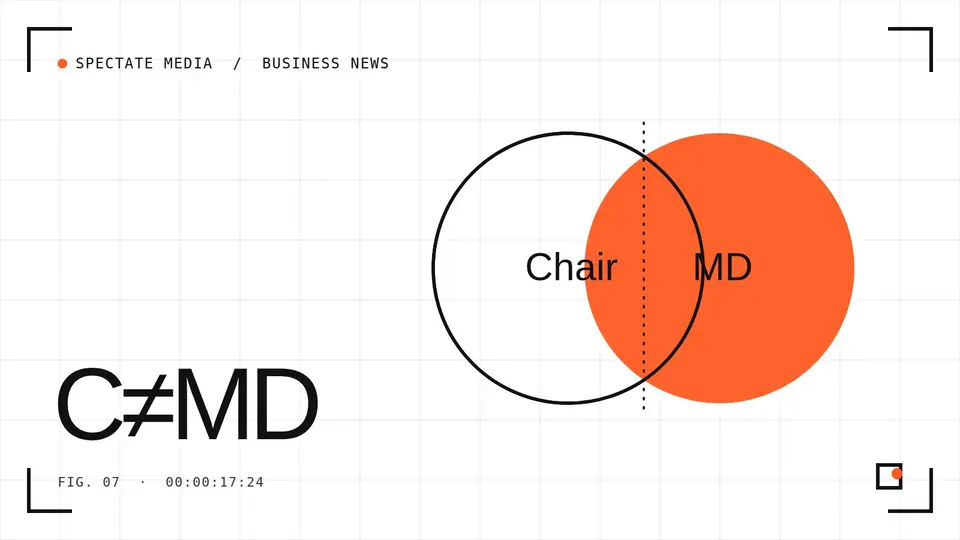
Should one person chair the board and run the company? In India this stopped being a regulatory question for listed companies in 2022. It is now a governance choice, and boards make it under the eye of investors and proxy advisers. We have not found verified, India-wide data showing that splits are rising, so this piece explains the framework rather than asserting a trend.
What the law says today
The Companies Act 2013 bars one individual from being appointed chairperson and managing director or CEO at the same time, unless the articles allow it or the company does not carry multiple businesses. Section 203 also carves out certain multi-business companies that appoint separate CEOs for each business, as notified by the Central Government. Check the current text and your articles.
For listed companies, SEBI went further and then stepped back:
- The Kotak Committee recommended the separation in 2017.
- SEBI approved it in March 2018 and made it a mandatory LODR requirement for the top 500 listed entities, with a deadline of 1 April 2020 that was later extended to 1 April 2022.
- In February 2022 SEBI decided to make it voluntary, citing unsatisfactory compliance: 54% of the top 500 had complied by 31 December 2021.
- Regulation 17(1B) was omitted by notification dated 22 March 2022.
As of September 2026, we found no reinstated mandate. Confirm the current LODR text.
Why board composition is tied to the choice
Regulation 17(1)(b) links the independent-director share to the chair. If the chair is a non-executive director, at least one-third of the board must be independent. If the chair is executive, or there is no regular non-executive chair, at least half must be independent. A non-executive chair who is a promoter or related to one also triggers the half requirement.
So the decision changes the arithmetic of the whole board, not just two titles.
The arguments on each side
For separating. The chair supervises management, and the MD or CEO is management. Separating the roles gives the board an agenda-setter who does not report to himself or herself, and it forces succession planning. IiAS made the family-business version of this point in December 2021: requiring the chair and CEO to be unrelated tests succession planning and forces promoter families to make choices they may not be ready for.
For combining. A single leader can speed coordination and carry deep operating knowledge. Some boards offset the concentration with a lead independent director.
A trap on the way. IiAS also warned of an unintended result. If promoters keep an executive role and appoint an independent director as chair, the company may end up with only one-third independent directors, where a promoter-executive chair would have required half.
For perspective outside India, a Conference Board study reported in the Harvard Law School Forum found 42% of S&P 500 chairs were combined with the CEO in 2025, and that boards describe the structure as context dependent, changing mostly at leadership transitions. That is US data and not a benchmark for Indian boards.
What we could not verify
We could not verify the claim that investor expectations are shifting the Indian default. That may be true for some investors, but it needs current data from proxy advisers or exchange filings, which we have not seen. The most recent India figures we could confirm are from 2021: IiAS counted 229 of the NIFTY 500 as compliant at 30 October 2021, with 204 of the 244 non-compliant companies having an executive chair. Those numbers predate the 2022 change and should not be read as today's picture.
What to do with this
These are considerations, not advice to any company.
- Check your articles of association and the Section 203 position before any change.
- Map how a split changes the independent-director requirement under Regulation 17(1)(b).
- Decide what the chair's job actually is: agenda control, CEO evaluation, investor engagement, succession.
- Where the chair is a promoter or relative, consider the role of a lead independent director and the disclosures that explain the structure.
- Time any change to a natural transition, and document the reasoning.
- Ask proxy advisers and major investors how they view your structure before your next AGM notice.
- ThePrint on SEBI making the separation voluntary (Feb 2022)
- Taxmann on the omission of Regulation 17(1B) (22 March 2022)
- Section 203 of the Companies Act 2013
- LODR Regulation 17 (board composition)
- IiAS Institutional Eye on Chair and CEO role separation (Dec 2021)
- Harvard Law School Forum on CEO and chair leadership (May 2026)
This article is journalism and commentary. It is not a recommendation to buy or sell any security, and it is not professional advice. Read the full disclaimer.