The Securities and Exchange Board of India (SEBI) has revised the timings and the operating framework of the Closing Auction Session in the equity cash market. In the same circular it also changed how stock and index derivatives contracts are settled on expiry day. Most of the new provisions take effect on 7 December 2026.
The new closing window
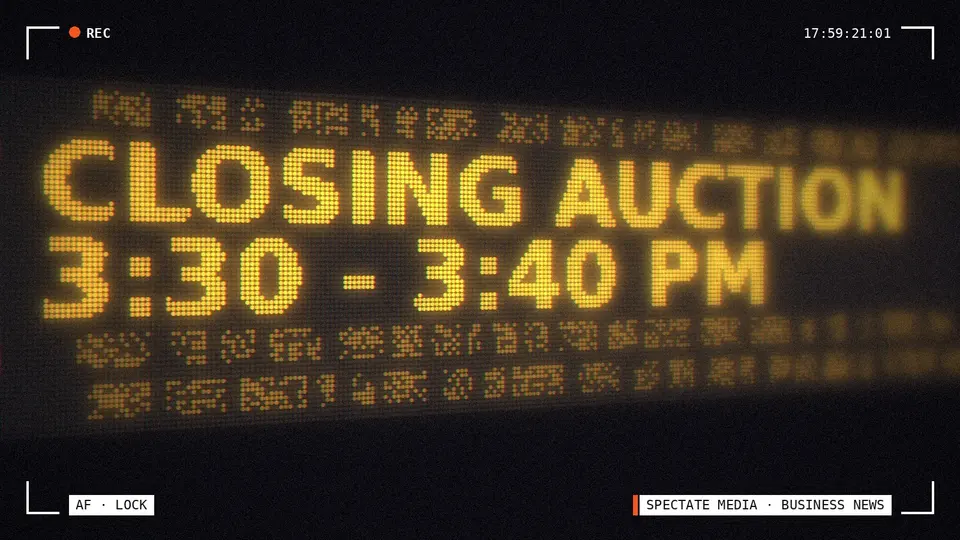
Under the revised framework, the Closing Auction Session will last 10 minutes, from 3:30 pm to 3:40 pm, on every trading day. The session is split into phases, which are used to work out a reference price and to take in orders.
The window for entering orders will not close at a fixed time. It will shut at a random moment between 3:38 pm and 3:40 pm. A random cut-off means no participant knows the exact last second in which an order can be placed.
After the auction, a post-closing session in the cash market will run from 3:50 pm to 4:00 pm. Trades in that session will be executed at the closing price.
Derivatives hours
Stock and index derivatives will trade until 3:45 pm, a few minutes after the cash market's auction ends. Expiry days follow a different rule. On those days, trading in expiring index derivatives stops at 3:30 pm, while stock derivatives continue to trade until 3:45 pm.
How expiry prices will be set
SEBI also set out the method for final settlement prices on expiry day. For index derivatives, the settlement price will be based on the value of the underlying index, worked out from the volume-weighted average prices (VWAP) of its constituent stocks over the last 30 minutes of continuous trading.
For stock derivatives, the settlement price will be based on the VWAP of the underlying stock over the same 30-minute period.
Orders that do not execute
The circular also covers orders left unexecuted when continuous trading ends. It sets out when such orders move into the Closing Auction Session. Under specified conditions, iceberg orders, which show only part of their size to the market, will be converted into fully disclosed limit orders.
The provisions on unexecuted limit and iceberg orders take effect later than the rest, on 8 February 2027.
Timetable for exchanges
SEBI has asked stock exchanges and clearing corporations to make the system and procedural changes needed, in consultation with the regulator. They have seven days from the date of the circular, which was issued on 15 October, to do so.
What boards and CFOs should note
For listed companies and the teams that watch their share price, the main change is to how the day's closing price is formed. That change applies from 7 December 2026, with the order-handling rules following on 8 February 2027.
For treasury desks that hedge with stock or index derivatives, two details change: the expiry-day trading hours and the 30-minute VWAP basis for settlement. Any programme that places orders near the close, such as a buyback, will run under the new timings once the rules apply.
Source: News On AIR, 16 October 2026. This is a summary of a news report, published as general information. It is not legal, tax or investment advice.
This article is journalism and commentary. It is not a recommendation to buy or sell any security, and it is not professional advice. Read the full disclaimer.