Mahindra & Mahindra reported consolidated Q2 FY27 revenue of ₹57,553 crore and profit after tax of ₹4,588 crore, both up 25% year on year. The quarter showed the benefit of the group’s diversified portfolio, but also exposed pressure in farm equipment and several margin-sensitive businesses.
The analysis below is based only on M&M’s official 5 November results release and management commentary published with it.
Quarter snapshot
- Consolidated revenue: ₹57,553 crore, up 25%.
- Consolidated PAT: ₹4,588 crore, up 25%.
- Annualised return on equity: 21.0%.
- Auto quarterly volumes: 331,000, up 26%.
- Tractor volumes: 116,027, down 6%.
What worked
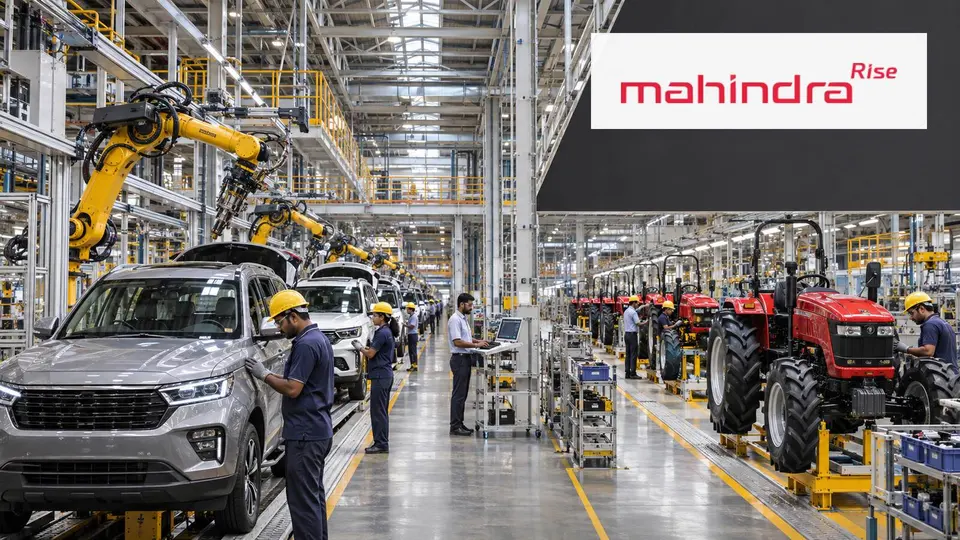
Automotive consolidated revenue rose 39% to ₹37,756 crore and PAT increased 55% to ₹2,388 crore. SUV revenue market share reached 24.3%, while electric SUVs held a 30.1% revenue share. Auto consolidated PBIT margin improved 110 basis points sequentially to 8.8%.
Services also contributed: Mahindra Finance assets under management grew 15%, Tech Mahindra’s EBIT margin reached 14.8%, and Mahindra Logistics reported positive PAT. Management described the balance sheet and cash generation as providing flexibility to keep investing.
What weakened
Farm consolidated revenue fell 6% to ₹9,572 crore and PAT declined 9% to ₹1,053 crore. Standalone farm PBIT margin dropped 300 basis points year on year to 16.8%, alongside a 6% fall in tractor volumes. Management attributed part of the decline to the festive-season shift, but the numbers also show sensitivity to input costs and demand timing.
Standalone auto PBIT margin was 7.7%; excluding electric-SUV contract-manufacturing arrangements it was 9.1%, down 120 basis points year on year. The official release also flags significant commodity and geopolitical headwinds.
Guidance and risks
Management maintained a focus on consistent profitable growth rather than issuing a simple group-wide numerical forecast. Key risks are commodity inflation, global supply disruption, uneven rural demand, execution of electric-vehicle investments and the possibility that strong auto volume growth does not translate proportionately into margins.
For boards and investors, the central question is whether auto and services can sustain their momentum while farm margins normalise and newer investments absorb capital.
Source: Mahindra & Mahindra Q2 FY27 official results release. This is an analytical summary of an official company release, not investment advice. <!-- evening-batch retry marker -->
This article is journalism and commentary. It is not a recommendation to buy or sell any security, and it is not professional advice. Read the full disclaimer.