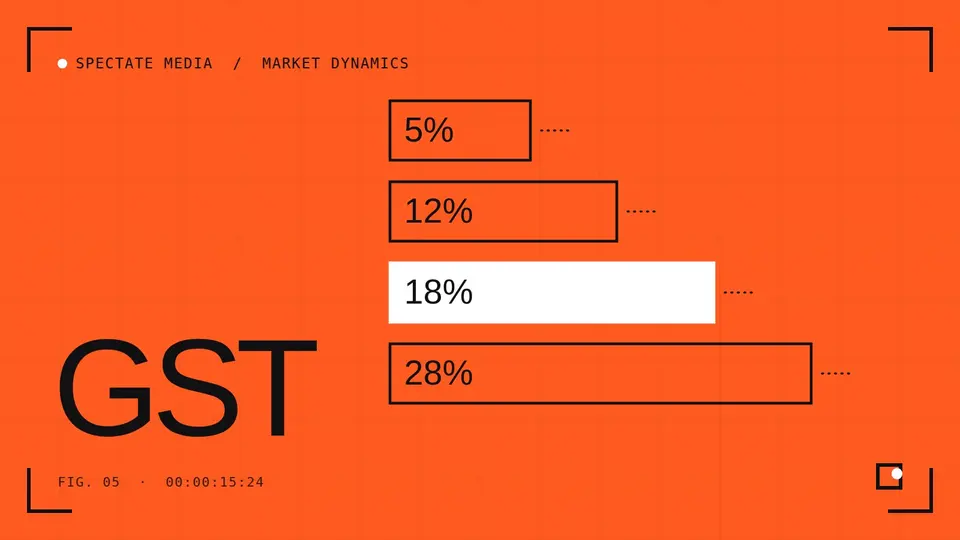
The GST Council's 56th meeting replaced a four-slab structure with two main rates and one special rate. Most changes took effect on 22 September 2025, so a year has passed. The question for companies is how far the cuts reached consumer prices, and what that means for pricing, margins and compliance.
The published evidence is limited. We found one study that measured price changes across categories, and we found no reliable data on pass-through by sales channel. What follows separates what is measured from what is not.
What changed
The Council recommended a standard rate of 18%, a merit rate of 5% and a 40% de-merit rate for select items, including certain premium vehicles, motorcycles above 350cc and aircraft for personal use. Tobacco products were handled separately, pending compensation cess obligations. The Council also addressed inverted duty structures. Its press release records man-made textiles moving from 18% or 12% to 5%, and certain fertiliser inputs such as sulphuric acid, nitric acid and ammonia from 18% to 5%. Several services, including hotel rooms priced under Rs 7,500 a day, moved to 5%.
What one study found
The National Institute of Public Finance and Policy (NIPFP) compared average consumer price index values for 355 items in the four months before the change (May to August 2025) with the four months after (October 2025 to January 2026), as reported by Business Standard in March 2026.
The results diverged by category:
- Durables showed clear price falls: air conditioners down 6.40%, cars and jeeps down 7.52%, motorcycles and scooters down 5.19%.
- Everyday goods did not: liquid milk was up 0.83%, ghee up 0.77% and hair oil and colour products up 2.77%.
The authors concluded that transmission was incomplete for essentials, and suggested that producers of durables were more likely to pass on cuts to stimulate demand. They also cautioned that the observation period was short and the analysis descriptive, not econometric.
Those caveats matter. Prices move for many reasons, including input costs, so a price rise after a rate cut is not by itself proof that the benefit was retained. The study does not measure margins, and it does not split results by retail channel. Claims that pass-through differs across channels or company sizes remain unverified here.
The compliance backdrop
Section 171 of the CGST Act, which obliges suppliers to pass on the benefit of a rate reduction, remains in the law. The enforcement machinery has changed. According to an ICSI journal article, the National Anti-Profiteering Authority gave way to the Competition Commission of India and then to the Principal Bench of the GST Appellate Tribunal. From 1 April 2025 no new anti-profiteering complaints are accepted, though those filed earlier continue.
The same article concludes that delivery of rate-cut benefits now depends more on voluntary compliance, competition and governance. Section 171 itself is unchanged, so companies should not read the closed complaints window as the end of the obligation. Confirm the current position with your tax adviser as of September 2026.
Where pricing decisions get difficult
Three situations tend to need judgement, and none is settled by the study above.
- Rate cut on output, unchanged input cost. Margin can rise if prices are held. The company should be able to explain why, and to show what happened to the tax-inclusive price.
- Inverted duty correction. Where the rate on inputs was higher than on outputs, the correction affects working capital and credit balances. The treatment of any accumulated credit should be reviewed.
- Move to the 40% rate. Here the tax-inclusive price rises unless the company absorbs it, and the response depends on demand elasticity and competitive position.
What to do with this
These are considerations, not tax advice.
- Boards might ask management to show, for each product line touched by the rate change, the tax-inclusive price before and after, and the reasons for any difference.
- CFOs might keep a record of pricing decisions taken after 22 September 2025, in case the basis for retaining any benefit is later questioned.
- Finance teams might review input tax credit balances in categories where the rate structure was corrected.
- Anyone relying on industry commentary about pass-through might ask whether it rests on measured prices or on anecdote, and over what period.
This article is general information and not legal, tax or investment advice.
This article is journalism and commentary. It is not a recommendation to buy or sell any security, and it is not professional advice. Read the full disclaimer.